
The rainbow earrings case: five days in detention for a seven-colour rainbow
Court case · 2024. The prosecution of Anastasia Yershova over rainbow earrings: from five days in detention to the Supreme Court’s decision of 21 November 2024.
Contents
Anastasia Yershova’s case was one of the first known cases in Russia involving the display of LGBT symbols as symbols of an extremist organisation following the Supreme Court’s decision of 30 November 2023. It was the first known case in which administrative detention was imposed on these grounds, with the wearing of jewellery prompting the proceedings.
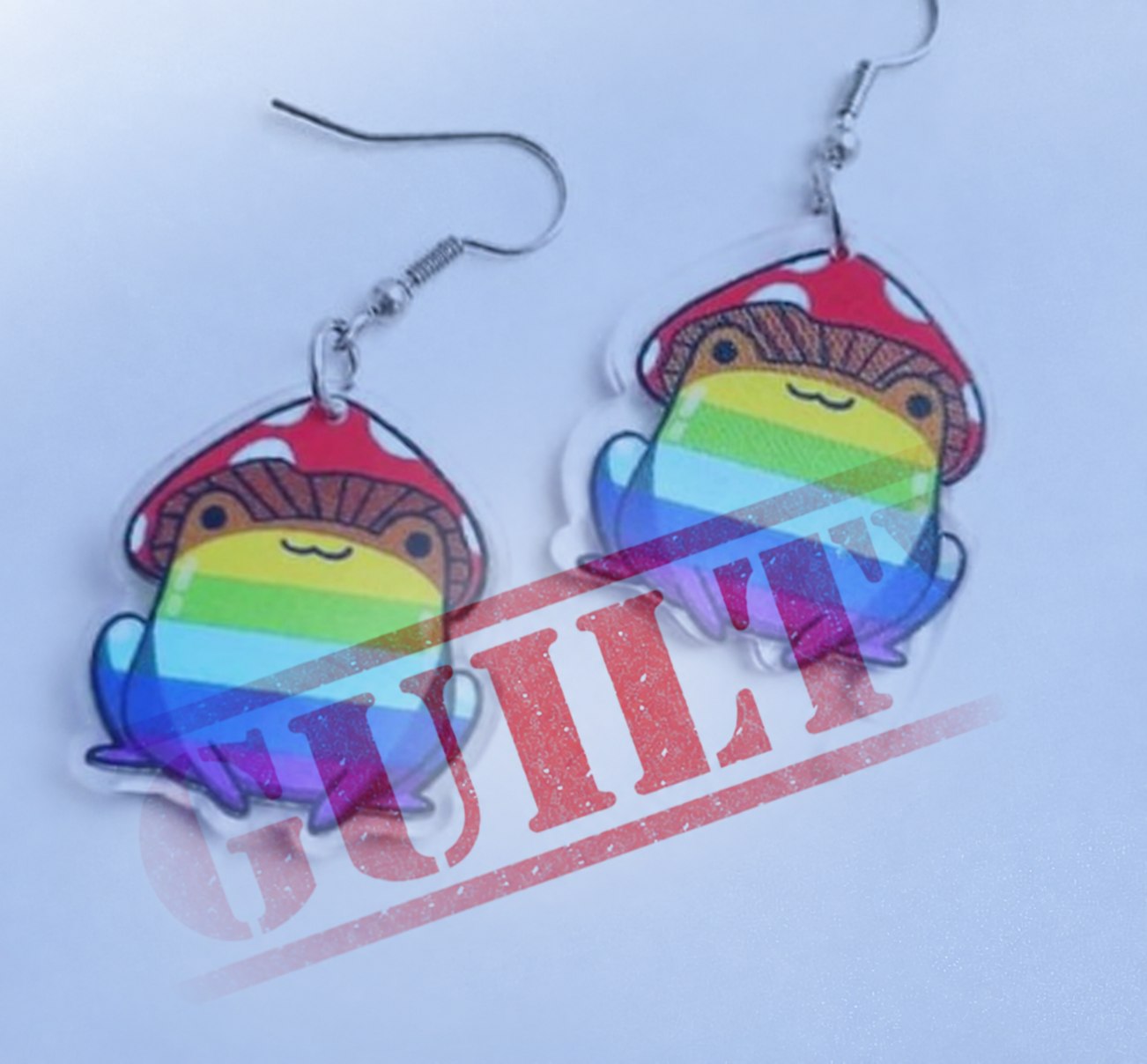
In January 2024, the Nizhny Novgorod resident was detained over frog-shaped earrings coloured in the seven colours of the rainbow. The court treated them as a public display of symbols of an extremist organisation and sentenced Anastasia to five days of administrative detention under Article 20.3, Part 1 of the Russian Code of Administrative Offences.
The appeal
On 5 February 2024, shortly after Anastasia’s release, her lawyer Artyom Nikitin filed an appeal with the Nizhny Novgorod Regional Court. The defence asked for the district court’s ruling to be overturned and the case dismissed, arguing that no administrative offence had occurred.
The main point of dispute was the image on the earrings. The defence pointed out that they showed a seven-colour rainbow with a light blue stripe, rather than a six-colour flag. In the lawyer’s view, the court of first instance had not explained which features of the prohibited symbols it had identified: the number and order of the colours, their orientation or their arrangement.
The case materials cited by the court also contained no reference to a public display of a six-colour flag. The earrings themselves were submitted to the court as evidence, but this did not change the decision.
The defence also drew attention to the circumstances of the video recording that had led to the case. The people filming Anastasia and her companion claimed to be acting on behalf of the Centre for Combating Extremism. The lawyer believed that the incident might have been a deliberate provocation. Anastasia also stated in writing that a police officer had recorded her account incorrectly.
The regional court’s decision
The Nizhny Novgorod Regional Court upheld the detention order. Immediately after the hearing, only the operative part of the decision was announced, without a detailed explanation of the reasons.
“We came for justice and did not get it,” was how lawyer Artyom Nikitin described the outcome of the appeal. The defence said it would continue to challenge the decision.
For the Aegis team, this case went beyond a dispute over a particular pair of earrings. It showed that an image of an ordinary seven-colour rainbow could lead to prosecution under the provision on displaying extremist symbols.
The case reaches the Supreme Court
On 21 November 2024, the Supreme Court of the Russian Federation upheld the lower courts’ decisions. In its ruling, the court stated that Anastasia had publicly displayed symbols of the LGBT social movement, which had been declared extremist by the Supreme Court’s decision of 30 November 2023.
At every stage of the proceedings, the defence showed the courts the earrings themselves: two frog figures with seven coloured stripes. The argument that a seven-colour rainbow differs from a six-colour flag did not result in the five-day detention sentence being overturned.
The Aegis team supported the case and helped seek a review of the decision through the Russian legal system.